SCRIPTURE
STUDIES
VOLUME THREE - THY
KINGDOM COME
STUDY
X
THE TESTIMONY OF GOD’S STONE WITNESS
AND PROPHET, THE GREAT
PYRAMID IN EGYPT
THE
CORROBORATIVE
TESTIMONY
OF
GOD’S
STONE WITNESS
AND
PROPHET
THE
GREAT PYRAMID IN
EGYPT
PREFACE TO
STUDY X
A KINDLY
COMMENT ON THIS CHAPTER
WHEN IN
MANUSCRIPT, FROM THE PEN
OF THE ESTEEMED
PROF. C. PIAZZI
SMYTH, F.R.S.E., F.R.A.S.
EX-ASTRONOMER ROYAL FOR SCOTLAND
Brother William M. Wright, on learning that this
chapter on the Great Pyramid was written, requested that he might have the
reading of it before it would be put into type, as he had already
considerable knowledge of the Pyramid.
This we gladly granted, assuring him of our desire for all the
criticism possible. After
reading the MS., Bro. Wright concluded that, as we desired criticism, the
higher the standing of the critic the better.
Accordingly he made a typewritten copy of the MS., and by
permission mailed it to Prof. C. Piazzi Smyth, who is generally accorded a
greater knowledge of the Great Pyramid’s construction and measurements
than any other man in the world, requesting that he examine the MS.
carefully and note upon it any criticism he might have to offer in the
interest of the truth. The
Professor’s answer to that letter, together with the MS. copy sent him,
which bore his marks of criticism, when received were sent to the author.
We thank Bro. Wright and Prof. Smyth for their kindness, and have
followed the corrections indicated; which, however, only three in all, we
were pleased to note were not of special importance.
Only one of the criticisms was upon measurements, and it showed a
variance of only one inch, which we gladly corrected. [page 312]
Thinking it might be interesting to our readers we give below Prof.
C. Piazzi Smyth’s Letter.
Clova,
Ripon, England, Dec. 21, 1890 Wm.
M. Wright, Esq.,
Dear
Sir: I have been rather longer than I could have wished in looking
over the MS. of your friend, C. T. Russell of Allegheny, Pa., but
I have now completed a pretty careful examination, word by word. And
that was the least I could do, when you so kindly took the pains to
send
it with such care between boards by registered parcel, with every page
flat, and indited by the typewriter in place of the hand.
At
first I could only find slips of the said typewriter, but as I progressed
through the pages, the powers, the specialties and the originalities
of the Author came out magnificently; and there were not a few
passages I should have been glad to take a copy of for quotation, with
name, in the next possible edition of my own Pyramid book.
But of course I did nothing of that
sort, and shall wait with perfect patience and in most thankful mood of mind
for when the author of Scripture
Studies shall choose his own time for publishing.
So I merely
remark here that he is both good and new in much that he says on
the chronology of various parts of the Pyramid, especially the First
Ascending
Passage and its granite plug; on the Grand Gallery, as illustrating
the
Lord’s life; on the parallelisms between the King’s Chamber
and its granite, against the Tabernacle and its gold; and generally
on the confirmations or close agreements between Scripture and
the Great Pyramid, well commented on.
In
the meanwhile, it seems that I am indebted to you for your kind gift
of long ago of the first two volumes of Scripture Studies.
I did not at the time get further than the
first half of the first volume, finding the matter, as I thought, not quite so
new as I had expected. But
after having
profited, as I hope, so much by a thorough reading of this advanced
pyramid
chapter of the third volume, I must take up the first two
volumes again, de novo.
The
parcel will go back between its boards, registered. I remain, with
many thanks,
Yours respectfully,
C. Piazzi Smyth
STUDY X
THE
TESTIMONY OF GOD’S STONE WITNESS
AND
PROPHET, THE GREAT PYRAMID IN EGYPT
General
Description of the Great Pyramid — Why of Special Interest to
Christians — The Great Pyramid a Storehouse of Truth — Scientific, Historic and Prophetic
— Bible Allusions to It — Why, When and by Whom Built — Importance of Its Location — Its
Scientific Lessons — Its Testimony
Concerning the Plan of Redemption — The Plan of the Ages
— The Death and the Resurrection of Christ Indicated
— The Downward Course of the World, Ending in a Great Time of
Trouble — The Nature of the Trouble —
The Great Reformation Movement Marked
— Length of the Jewish Age Indicated — The “High
Calling” of the
Gospel Church Shown — The Course of the Church’s Consecration — The End
of the High Calling Marked — Date of the Second Advent of Christ
— How Restitution Blessings for the World are
Indicated — The Course of the World During the Millennial Age — Its End
— Contrast of the Two Conditions, Human and Spiritual, as
Indicated in the
Pyramid — The Pyramid Refutes Atheism, Infidelity and all Evolution Theories, and Verifies both the Plan of
the Bible and Its
Appointed Times and Seasons.
“In that day shall there be an altar to the Lord in
the midst of the land of Egypt and a pillar at the border thereof to the
Lord. And it shall be for a sign and for a witness unto the Lord of hosts
in the land of Egypt.” Isa. 19:19,20
[page 314]
THE
ancients recounted seven wonders of the world, and at the very head of the
list named the Great Pyramid of Gizeh. It is situated in Egypt, not far
from the present city of Cairo. No
other building in the world equals it in size.
One of the leading granite men of this country, who made a personal
inspection of the Great Pyramid, says: “There are blocks of stone in the
Pyramid which weigh three or four times as much as one of the obelisks. I saw a stone whose estimated weight was 880 tons.
There are stones in it thirty feet in length which fit so closely
together that you may run a penknife over the surface without discovering
the breaks between them. They
are not laid with mortar, either. There
is now no machinery so perfect that it will make two surfaces thirty feet
in length which will meet together as these wonderful stones in the Great
Pyramid meet.” It covers an
area of about thirteen acres. It
is 486 feet high and 764 feet broad at its base.
It is estimated that the Great Pyramid weighs six million tons, and
that to remove it would require six thousand steam engines, each drawing
one thousand tons. In fact,
the wealth of Egypt is not sufficient to pay laborers to demolish it.
From these facts it is evident that, whoever was its great
designer, he intended that it should be an enduring monument.
Viewed from whatever standpoint we please, the Great Pyramid is
certainly the most remarkable building in the world; but in the light of
an investigation which has been in progress for the past thirty-two years,
it acquires new interest to every Christian advanced in the study of
God’s Word; for it seems in a remarkable manner to teach, in harmony
with all the prophets, an outline of the plan of God, past, present and
future.
It should be remembered that, aside from the Great Pyramid here
referred to, there are others, some of stone and some of brick; but all of
them are mere attempts to copy it, and are in every way inferior—in
size, accuracy and internal arrangement.
And it has also been demonstrated that, unlike the Great Pyramid,
they contain no symbolic features, but were evidently designed and used as
sepulchers for the royal families of Egypt.
The Great Pyramid, however, proves to be a storehouse of important
truth—scientific, historic and prophetic—and its testimony is found to
be in perfect accord with the Bible, [page 315]
expressing the prominent features of its truths in
beautiful and fitting symbols. It
is by no means an addition to the written revelation: that revelation is
complete and perfect, and needs no addition.
But it is a strong corroborative witness to God’s plan; and few students can
carefully examine it, marking the harmony of its testimony with that of
the written Word, without feeling impressed that its construction was
planned and directed by the same divine wisdom, and that it is the pillar
of witness referred to by the prophet in the above quotation.
If it was built under God’s direction, to be one of his witnesses
to men, we might reasonably expect some allusion to it in the written Word
of God. And yet, since it was
evidently a part of God’s purpose to keep secret, until the Time of the
End, features of the plan of which it gives testimony, we should expect
that any reference to it in the Scriptures would be, as it is, somewhat
under cover—to be recognized only when due to be understood.
Isaiah, as above quoted, testifies of an altar and pillar in the
land of Egypt, which “shall be for a sign and for a witness
unto the Lord of hosts in the land of Egypt.”
And the context shows that it shall be a witness in
the day when the great Savior and Deliverer shall come to break
the chains of oppression and to set at liberty Sin’s captives—of which
things our Lord preached at his first advent. (Luke 4:18)
The scope of this prophecy is but dimly seen, however, until Egypt
is recognized as a symbol or type of the world of mankind, full of vain
philosophies, which only darken their understandings, but ignorant of the
true light. As Israel
typified the world which shall be delivered from the bondage of Sin by the
great antitype of Moses, and whose sin-offering has been given by the
antitype of Aaron, so Egypt represents the empire of Sin, the dominion of
death (Heb. 2:14), which for so long has held in chains of slavery many
who will be glad to [page 316]
go forth to serve the Lord under the leadership of
one like unto but greater than Moses. Acts 3:22,23
In many passages of Scripture the symbolic character of Egypt is
indicated; for instance, Hosea 11:1 and Matt. 2:13-15. Here, aside from
the fact that our Lord as a babe was for a time actually in the land of
Egypt, and Israel also for a time actually in Egypt, there is evidently a
typical significance as well. The
Son of God was in the world for a time for the sake of those he came to
redeem and deliver; but he was called out of it—Egypt—to the higher,
divine nature. Likewise those who are called to be his brethren and
joint-heirs, the “members of his body,” the true Israel of God, are
called out of Egypt; and the Master testifies, “They are not of this
world, even as I am not of this world.”
Isaiah (31:1,3), referring to the great trouble now impending,
says, “Woe unto them that go down to Egypt [to the world] for help [for
worldly ideas and plans, and for counsel as to how they should act in the
crisis of this great day]; and stay on horses [who endeavor still to ride
the old, false doctrinal hobbies], and trust in chariots [worldly
organizations] because they are many; and in horsemen [the great leaders
in false doctrines] because they are very strong; but who look not unto
the Holy One of Israel, neither seek the Lord [for the safety and victory
in this day of trouble will not be with the multitude]!...Now the
Egyptians are men, and not God, and their horses flesh, and not spirit.
When the Lord shall stretch out his hand [his power—the power of
the truth and other agencies—as he will do shortly], both he that
helpeth shall fall, and he that is helped [by the powers of Egypt—the
world’s ideas] shall fall down, and they all shall fail together.”
It will be after all human plans and schemes have failed them, and
when men shall have learned their own sinfulness and helplessness, that
they will begin to cry unto the [page 317]
Lord for help. Then
Jehovah will show himself a great Savior; and he has already prepared the
Great Pyramid as a part of his instrumentality for convincing the world of
his wisdom, foreknowledge and grace.
“It shall be for a sign and for a witness unto the Lord of hosts
[a witness to his foreknowledge and to his gracious plan of salvation, as
we shall presently see] in the land of Egypt: for they [the
Egyptians—the poor world, during the great time of trouble coming] shall
cry unto the Lord because of the oppressors, and he shall send them a
Savior, and a great one; and he shall deliver them.
And the Lord shall be known to Egypt [the world], and the Egyptians
shall know the Lord in
that day [in the Millennial day—at the close of the time of
trouble], and shall do service with sacrifice and oblation: yea, they
shall make vows unto the Lord and perform them. But the Lord shall smite
Egypt [the world—in the great time of trouble just at hand]. He shall smite and heal it. And they shall return unto the
Lord, and he shall be entreated of them, and shall heal them.” Isa.
19:19-22
While the additional, corroborative evidence given by the Great
Pyramid to the written Word of God will be a fresh cause of rejoicing to
the saints, it is manifest that its witnessing is chiefly intended for the
world of mankind during the Millennial age.
The testimony of this peculiar and remarkable witness will give to
mankind fresh ground for faith and love and zeal, when in due time their
hearts are prepared for the truth. It
is remarkable, too, that (like the Plan of the Ages in the written Word)
this stone “Witness” kept silence until now, when its testimony shall
shortly be delivered to (Egypt) the world.
But the saints, the friends of God from whom he will hide nothing,
are privileged to hear the testimony of this witness now, before the
worldly mind is ready to appreciate its testimonies.
Only when ready to obey the Lord can any appreciate his witnesses. [page 318]
Jeremiah (32:20), when speaking of God’s mighty works, declares
that he hath “set
signs and wonders in the land of Egypt, even unto this day.”
God showed signs and wonders in Egypt when he brought Israel out in
triumph; but he also “set signs and wonders”
there, which remain “even unto this [our] day.” The Great Pyramid, we believe, is the principal one of these
very signs and wonders; and it now begins to speak to scientists in their
own language, and through them to all men.
The Lord’s questions and statements to Job (38:3-7), concerning
the earth, find a remarkable illustration in the Great Pyramid, which is
believed, in itself and by its measurements, to represent the earth and
God’s plan with reference to it. The
illustration used is that of a building, and we believe that it fits only
to a structure of pyramid shape. The
language, while it applies primarily to the earth, is framed to fit the
illustration given in the Great Pyramid.
First, the preparation of the foundation, the rock on which the
Great Pyramid is built, is noted. Second,
the arrangement of its measures, a feature very prominently shown in the
Great Pyramid, which abounds in significant measurements. “Who hath
stretched the line upon it?” The
perfection of the shape of the Great Pyramid, and its exactness in every
respect, prove that its construction was guided by some master architect.
“Whereupon are the sockets thereof made to sink?”
The Great Pyramid has four corner socket-stones sunk into the solid
rock. “Or who laid the
corner-stone thereof?” A
pyramid has five corner-stones, but the reference here is to one
particular corner-stone—the top stone. The four sunk as socket-stones
into the rock have already been referred to, and the remaining one is the
top corner-stone. This is the most remarkable stone in the
structure—itself a perfect pyramid, the lines in the entire structure
conform to it. The question,
therefore, with reference to it is significant, [page 319]
and calls attention to its peculiar fitness, and the
wisdom and skill which prepared and placed it as the top stone.
This ancient structure being thus repeatedly referred to in the
Scriptures, we cannot doubt that, if questioned, this “Witness” of the
Lord in the land of Egypt will bear such testimony as will honor Jehovah,
and fully correspond with his written Word.
We thus introduce this “Witness” because the inspiration of its
testimony will doubtless be as much disputed as that of the Scriptures, by
the prince of darkness, the god of this world, and those whom he blinds to
the truth.
Why,
When and by Whom
was
the Great Pyramid Built?
This question has been much discussed of late years, from both
scientific and Scriptural standpoints.
For thousands of years no satisfactory answer to the question was
discovered. The old theory
that it was built as a vault or tomb for an Egyptian king is unworthy of
credence; for, as we shall see, it required more than the wisdom of the
present day, to say nothing of that of Egypt four thousand years ago, to
design such a structure. Besides,
it contains nothing in the way of casket, mummy or inscription.
It was not until we had come into the time called in Daniel’s
prophecy “the Time of the End,” when knowledge should be increased,
and the wise should understand God’s plan (Dan. 12:4,9,10), that the
secrets of the Great Pyramid began to be understood, and our questions
began to have a reasonable answer.
The first work of importance on the subject, proving that the Great
Pyramid possessed scientific features, was by Mr. John Taylor, of England, A.D.
1859, since which time the attention of many able minds has been given to
the further study of the testimony of this wonderful “Witness”;
especially [page 320]
since Prof. Piazzi Smyth, Astronomer-Royal for
Scotland, visited it, for several months made its peculiarities a study
and gave to the world the remarkable facts of its construction and
measurements, and his conclusions therefrom. To his scholarly and
scientific work, “Our Inheritance in the Great Pyramid,” we are mainly
indebted for the data made use of in this chapter.
Our illustrations are copies of a few of the twenty-five plates
with which the latest edition of that work is embellished.
A few years after Prof. Smyth’s return, came the suggestion that
the Great Pyramid is Jehovah’s “Witness,” and that it is as
important a witness to divine truth as to natural science.
This was a new thought to Prof. Smyth, as well as to others.
The suggestion came from a young Scotsman, Robert Menzies, who,
when studying the scientific teachings of the Great Pyramid, discovered
that prophetic and chronological teachings coexist in it.
Soon it became apparent that the object of its construction was to
provide in it a record of the divine plan of salvation, no less than the
record of divine wisdom relating to astronomical, chronological,
geometrical, and other important truths.
However, not having discerned the scope and completeness of the
plan of salvation revealed in the Scriptures, these gentlemen have thus
far failed to note the most wonderful and beautiful features of the Great
Pyramid’s testimony in this direction, which we now find to be a most
full and complete corroboration of the plan of the ages and the times and
seasons therewith associated, as taught in the Scriptures and presented in
this and the preceding volumes of the Scripture Studies series.
And, further, we see that this storehouse of knowledge, like the
major part of the Bible store, was kept purposely sealed until its
testimony should be needed and appreciated.
Does this imply that its great Architect knew that a time would
come when its testimony [page 321]
would be necessary?
In other words, that a time would come when God’s written Word
would be lightly esteemed, and even his very existence questioned? when
human philosophy, under the name of science, would be lauded and every
proposition subjected to its tests? Has
God decided to prove himself and his wisdom by those very tests? So it would appear. This
structure will yet confound the wisdom of the wise as a “Witness” for
the Lord of hosts—“IN THAT DAY”—which is already begun.
Prof. Smyth has concluded that the Great Pyramid was built in the
year 2170 B.C., reaching this conclusion, first, from astronomical
observations. Perceiving that
the upward passage angles correspond to a telescope, and that the
“Entrance Passage” corresponds to an astronomer’s “pointer,” he
set about to investigate to what particular star it could have pointed at
any time in the past. Calculations
showed that a
Draconis, the dragon-star, had occupied a position in the heavens
which looked directly down the entrance, at midnight of the autumnal
equinox, B.C. 2170. Then,
considering himself as an astronomer at that date, with his pointer fixed
upon a Draconis, and considering the ascending passages as though
they were a telescope, which they much resemble, he calculated what
constellation or what notable star would have been before his telescope
thus fixed at the particular date indicated by his pointer, and found that
it must have been the Pleiades. So
wonderful a coincidence convinced him that the date of the Great
Pyramid’s building was thus indicated; for a Draconis is no less a symbol of sin and Satan than Pleiades
is a symbol of God and the center of the universe. The Great Pyramid thus indicates that its Architect knew of
the prevalence of evil and of its domination over the downward course of
mankind, and indicates also what lies beyond all human sight—that the
only hope for the race is in Jehovah.
[page 322
This conclusion of Prof. Smyth’s as to the date of the Great
Pyramid’s building, was most abundantly corroborated, later, by certain
measurements by which the Great Pyramid indicates its own date of
construction. A realization of the fact that the Great Pyramid exhibits a
wisdom of design which the Egyptians could not have possessed—a divine
wisdom which must have been worked out under the supervision of some
inspired servant of God—has led to the conjecture that Melchizedek was
its builder. He was “king
of Salem [that is, king of peace] and priest of the Most High God,” and
as a person and type occupied so high a position as to be a blesser of
Abraham, who also paid him tithes. Of
this we can know little, except that Melchizedek was a great and peaceful
king, and that he lived about that time, and not far distant from the site
of the Great Pyramid.
It is conjectured that Melchizedek, though not himself an Egyptian,
used Egyptian labor for the construction of the Great Pyramid. And to some extent the traditions of Egypt support such a
theory. They reveal the fact
that Egypt had a peculiar invasion about this date by a people whom
tradition merely denominates Hyksos
(i.e., Shepherd Kings or Peaceful Kings).
These invaders seem not to have attempted to disturb the general
government of Egypt, and, after staying a time for some purpose not
recognized by the tradition, they left Egypt as peacefully as they had
come. These Hyksos
or Peaceful Kings are supposed to include Melchizedek, and are assumed to
have been the builders of the Great Pyramid—God’s altar and
“Witness” in the land of Egypt.
Manetho, an Egyptian priest and scribe, is quoted by Josephus and
others as saying: “We had formerly a king whose name was Timaus.
In his time it came to pass, I know not how, that the deity was
displeased with us; and there came up from the East, in a strange manner,
men of ignoble
[page 323]
[page 324]
(Blank
Page)
[page 325]
race [not warriors], Hyksos, who had the
confidence to invade our country and easily subdue it by their power
without a battle. And when
they had our rulers in their hands, they demolished the temples of the
gods.”
Its
Peculiar Location
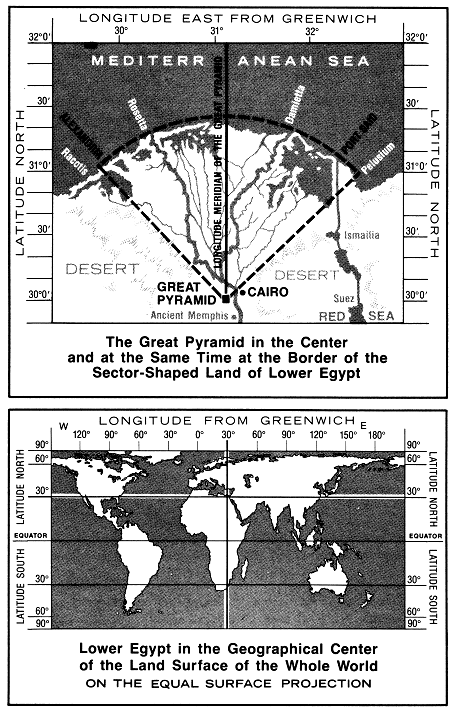
The Great Pyramid is situated on an elevated rocky plain,
overlooking the river Nile, not far from the city of Cairo, in Egypt. A remarkable thing in connection with its situation is, that
the delta of the Nile forms a seacoast which in shape is a true quarter
circle, with the Great Pyramid marking the inner angle.
This relationship of the Great Pyramid to the coast was discovered
by Mr. Henry Mitchell, Chief Hydrographer of the United States Coast
Survey, who visited Egypt in 1868 to report the progress of the Suez
Canal. His observation of the
regularity of the curvature along the whole of Egypt’s northern coast
led him to conclude that some central point of physical origination was
indicated. On searching for
this grand center, he found it marked by the Great Pyramid, which led him
to exclaim: “That monument stands in a more important physical situation
than any other building erected by man.”
A line drawn from the entrance passage due north would pass through
the northernmost point of Egypt’s coast; and lines drawn in continuation
of the northeast and northwest diagonals of the structure would enclose
the delta’s either side, thus embracing the fan-shaped country of Lower
Egypt. (See illustration,
page 323.) Built upon the
northernmost edge of the Gizeh cliff, and looking out over this sector, or
open fan-shaped land of Lower Egypt, it may be truly said to be at the
very border thereof, as well as in its nominal center, as described by the
prophet Isaiah. “In that day shall there be an altar to the Lord in
the midst of the land [page 326]
of Egypt, and a pillar [pyramid] at
the border thereof, to the Lord.
And it shall be for a sign and for a witness unto the Lord of hosts
in the land of Egypt.” Another
fact worthy of notice is that the Great Pyramid is located in the
geographical center of the land surface of the world—including North and
South America, unknown for centuries after the location and construction
of the Great Pyramid.
Its
Scientific Lessons
The Great Pyramid speaks to us, not by hieroglyphics, nor by
sketches, but only by its location, its construction and its measurements. The only original marks or figures found were in the
“Construction Chambers” over the “King’s Chamber”; there are
none whatever in the passages and rooms of the Pyramid proper.
The scientific lessons of the Great Pyramid we omit for economy of
space, because not one in a hundred ordinary readers would understand the
scientific terms, so as to appreciate the demonstrations, and especially
because they would be no part of the gospel which it is our mission to
present. Suffice it,
therefore, that we merely suggest the manner in which it teaches the scientist. For
instance: The measure of the base of the four sides, at the level of the
“sockets,” added, is found to be as many pyramid cubits as there are
days in four years, to the fraction—including the leap year fraction.
The measures diagonally across the base from northeast to
southwest, and from northwest to southeast, added, give as many inches as
there are years in the precessional cycle. This cycle astronomers had already concluded to be 25,827
years, and the Great Pyramid corroborates their conclusion. The distance to the sun it is claimed is indicated, by the
height and angle of the Great Pyramid, to be 91,840,270 miles, which
almost exactly corresponds with the latest figures reached by astronomers.
Astronomers until recently had calculated this distance to be from ninety
to ninety-six millions of miles, [page 327]
their latest calculation and conclusion being
ninety-two millions. The
Great Pyramid has also its own way of indicating the most correct standard
of all weights and measures, based upon the size and weight of the earth,
which it is also claimed to indicate.
Commenting upon the scientific testimony and the location of this
majestic “Witness,” Rev. Joseph Seiss, D.D. suggests:
“There is a yet grander thought embodied in this wonderful
structure. Of its five points
there is one of special pre-eminence, in which all its sides and exterior
lines terminate. It is the summit corner, which lifts its solemn index
finger to the sun at midday, and by its distance from the base tells the
mean distance to that sun from the earth.
And if we go back to the date which the Pyramid gives itself and
look for what that finger pointed to at midnight, we find a far sublimer
indication. Science has at
last discovered that the sun is not a dead center, with planets wheeling
about it, and itself stationary. It is now ascertained that the sun also is in motion,
carrying with it its splendid retinue of comets, planets, its satellites
and theirs, around some other and vastly mightier center.
Astronomers are not yet fully agreed as to what or where that
center is. Some, however,
believe that they have found the direction of it to be the Pleiades, and
particularly Alcyone, the central one of the renowned Pleiadic stars. To the distinguished German astronomer, Prof. J. H. Maedler,
belongs the honor of having made this discovery. Alcyone, then, as far as science has been able to perceive,
would seem to be ‘the midnight throne’ in which the whole system of
gravitation has its central seat, and from which the Almighty governs his
universe. And here is the
wonderful corresponding fact, that at the date of the Great Pyramid’s
building, at midnight of the autumnal equinox, and hence the true
beginning of the year* as still preserved in the
traditions of many nations, the Pleiades were distributed over the meridian of this Pyramid,
with Alcyone (A Tauri) precisely on the line. Here, then, is a pointing of the highest and sublimest
character that mere human science has ever been able so much as to hint,
and which would seem to breathe an unsuspected and mighty meaning into
that speech of God to Job, when he demanded, ‘Canst thou bind the sweet
influences of Pleiades?’”
—————
*The
beginning of the Jewish year, introduced by the Day of Atonement, as shown in Scripture Studies, Vol. II.
[page 328]
Its
Testimony Relating to the Plan of Redemption
While every feature of the Great Pyramid’s teaching is important
and of interest, our greatest interest centers in its silent but eloquent
symbolism of the plan of God—the Plan of the Ages.
It would be impossible, however, to understand God’s plan as
illustrated by it, had we not first discovered that plan in the Bible.
But having seen it portrayed there, it is strengthening to faith to
see it again so beautifully outlined here; and to notice, further, that
both the truths of Nature and the truths of Revelation are owned and
testified to by the same great Author in this wonderful stone
“Witness.”
In this aspect of its teaching, the Great Pyramid, viewed from
without, has a beautiful significance, representing the plan of God
completed, as it shall be at the end of the Millennial age.
The crowning feature will be Christ, the acknowledged Head over
all; and each other stone will be fitly framed into the glorious building,
complete and perfect. All this chiseling, polishing and fitting process
will then be completed, and all will be bound and cemented together, to
each other and to the Head, with love.
If the Great Pyramid, as a whole, represents the plan of God
complete, its top corner-stone should represent Christ, whom God hath
highly exalted to be Head over all. And
that it does represent Christ is indicated, not only by its exact fitness
as a symbol of Christ,*
but also by numerous references to the symbol by prophets and apostles and by our
Lord Jesus himself.
—————
*See
Vol. I, Chap. v; also the Chart of the Ages, Vol. I, x,y,z,W.
[page 329]
Isaiah (28:16) refers to Christ as the “precious corner-stone.”
Zechariah (4:7) refers to its placement at the top of the completed
edifice, with great rejoicing, saying, “He shall bring forth the
head-stone thereof with shoutings, crying, ‘Grace, grace unto it.’”
Doubtless when the head-stone of the Great Pyramid was laid there
was great rejoicing among the builders and all interested in it, to see
this crowning feature of the finished work.
Job also (38:6,7) speaks of the rejoicing when the chief
corner-stone was laid, and he specifies the head, or crowning
corner-stone, by mentioning the other four corner-stones first, saying,
“Whereupon are the socket-stones made to sink? or who laid the
corner-stone thereof, when the morning stars sang together and all the
sons of God shouted for joy?” (See
margin.) The Prophet David, too, refers to our Lord, and uses a figure of
speech exactly corresponding to that of this stone “Witness” of Egypt.
He says, prophetically, from the standpoint of the future, “The
stone which the builders rejected is become the head-corner-stone.
This is Jehovah’s doing. It is marvelous in our eyes.
This is the day [the Millennial day of Christ’s glory as the Head
and Ruler of the world] which Jehovah hath made; we will rejoice and be
glad in it.” (Psa. 118:22-24) Fleshly
Israel failed to accept Christ as their head-stone, and hence were
rejected from being the special house of God—Spiritual Israel instead
being built up into Christ the Head.
And we remember that our Lord applied this very prophecy to
himself, and showed that he was the rejected stone, and that Israel,
through their builders, the priests and Pharisees, were the rejecters.
Matt. 21:42,44; Acts 4:11
How perfectly the head-stone of the Great Pyramid illustrates all
this! The head-stone, being
first finished, would serve the workmen as a pattern or model for the
whole [page 330]
structure, whose angles and proportions must all be
conformed to it. But we can
readily imagine that, before this top-stone was recognized as a pattern
for the whole structure, it would be rejected, set at naught, by the
builders, some of whom could think of no place suitable for it; its five
sides, five corners and sixteen different angles making it unsuitable to
the structure until the very top-stone was needed, and then no other stone
would do. During all the
years in which the building work progressed, this Chief Corner-stone would
be a “stone of stumbling” and a “rock of offense” to those not
acquainted with its use and place; just as Christ is, and will continue to
be, to many, until they have seen him exalted as the Head-Corner-Stone of
God’s plan.
The pyramid figure represents perfection and completeness, and
speaks to us in symbol of the plan of God, showing that “in the
dispensation of the fulness of times, he will gather together [into one
harmonious family, though on different planes of being], under one Head,
all things in heaven and on earth, under Christ”—all not being
conformable being cut off. Eph. 1:10; 2:20-22—Diaglott
How
the Internal Construction of the
Great
Pyramid Outlines the Plan of Redemption
But while the outward testimony of this great structure is thus
complete, and in accord with God’s written revelation, its inner
construction is even more wonderful.
While its outward form illustrates the completed results of God’s
Plan of Redemption,*
the inner construction marks and illustrates every prominent feature of
that plan as it has developed from age to age, down to its glorious and
complete consummation. Here the stones upon the various levels or planes
represent the perfection of all who, under Christ Jesus our Head, shall become conformed to God’s
perfect will, as we have already seen from Scripture testimony. Some will
be perfected on the human plane and some on the spiritual and divine
planes or natures. Thus the
floor of the “King’s Chamber” is described as being on the fiftieth
course of masonry, that of the “Queen’s Chamber” on the twenty-fifth
course, and the lower end of the “First Ascending Passage,” if
extended by the “Plug,” as will presently be shown, would reach down
to the basal line of the Pyramid. Thus from its base-line upward the Great
Pyramid seems to stand as an emblem of God’s plan of salvation, or
lifting up out of sin and death, provided for all mankind.
The base-line thus corresponds with the date of the confirmation of
God’s promise to typical Israel—the beginning of the uplifting or
saving process.
—————
*See
the Chart of the Ages in Vol. I.
[page 331]
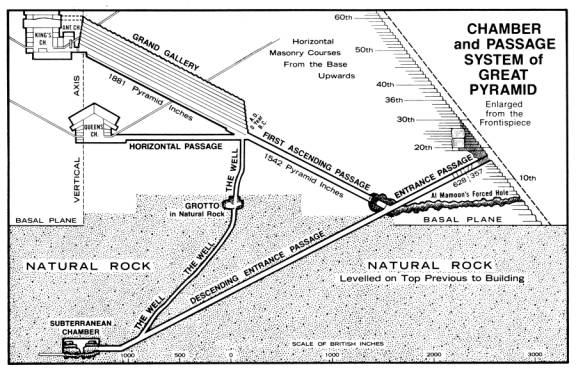
A careful study of the accompanying diagram, showing the interior
arrangement of this wonderful structure, is suggested. The Great Pyramid
has but one proper “Entrance Passage.” This
passage is regular, but low and slanting, and leads down to a little room
or “Subterranean Chamber,” cut in the rock.
This room is of peculiar construction, the ceiling being well
finished, while the sides are only commenced and the bottom is rough and
unfinished. This to some
minds has suggested the thought, “bottomless pit,” which term is used
in the Scriptures to represent disaster, oblivion and extinction.
This “Entrance Passage” fitly represents the present downward
course of mankind toward destruction; while the “Subterranean
Chamber,” by its peculiar construction, illustrates the great trouble,
disaster, destruction, the “wages of sin,” to which the downward
course leads.
The “First Ascending Passage” is of about the same size as the
“Entrance Passage,” from which it branches off.
It is small, low and difficult of ascent, but opens at its upper
end into a large, elegant hallway, called the “Grand Gallery,” [page 332]
the ceiling of which is at seven times the height of
the passages leading to it. The
low “Ascending Passage” is supposed to represent the Law dispensation,
and Israel as a nation, from the going out of Egypt.
There they left the nations of the world and their downward course,
to be God’s holy nation and under his law—proposing thenceforth to
walk an upward and more difficult path than that of the heathen world,
viz., to keep the Law. The
“Grand Gallery” is understood to represent the period of the Gospel
call—still upward and difficult, but not hampered as that behind it.
The loftiness and greater width of this passageway well represent
the grander hopes and greater liberties of the Christian dispensation.
On a level with the floor of the “Grand Gallery” at its lower
end, there starts a “Horizontal Passage” under it, which leads to a
little room commonly termed the “Queen’s Chamber.”
At the upper end of the “Grand Gallery” is another low
passageway, leading into a little room called the “Ante-Chamber” which
is of very peculiar construction, and which to some has suggested the idea
of a school—a place for instruction and testing.
But the chief room of the Great Pyramid, for both size and
importance of location, is a little farther along, and separated from the
“Ante-Chamber” by another low passageway. This room is known as the
“King’s Chamber.” Over it are a number of small apartments called
“Construction Chambers.” The significance of these, if they have any significance,
relates not to man, nor to any other creature which walks, but to spirit
beings; for it will be observed from the diagram that though the sides and
the top are squared and finished, there is no floor surface to any of
them. The “King’s
Chamber” contains a “Coffer” or stone box, the only piece of
furniture found in the Great Pyramid. Ventilation is provided in the
“King’s Chamber” by
[page
333]
[page 334]
(Blank Page)
[page 335]
two air-passages which pierce its walls on opposite
sides and extend to the outer surface—left for this purpose by the
builders. It has been
speculated by some that there are yet other rooms and passages for future
discovery; but we do not share this opinion; to us it seems that the
passages and rooms already discovered fully serve the divinely intended
purpose in witnessing to the entire plan of God.
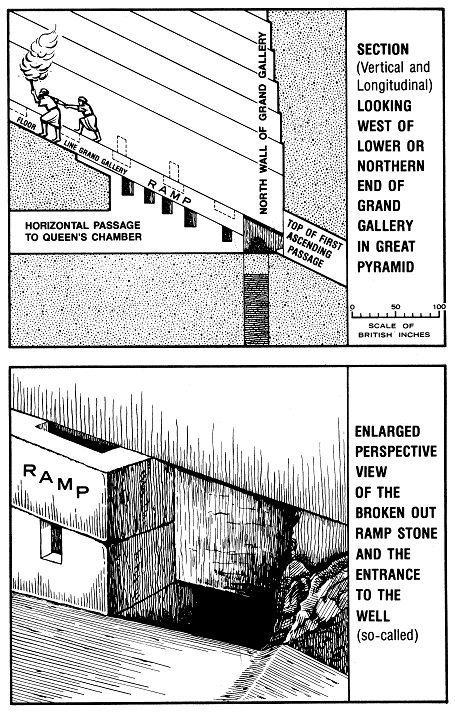
From the west side of the lower or north end of the “Grand
Gallery,” extending downward, there is an irregular passage called the
“Well,” leading into the descending “Entrance Passage.”
Its route passes through a grotto in the natural rock. The connection between this passage and the “Grand
Gallery” is very disordered. It
would appear that originally the passageway into the “Queen’s
Chamber” had been concealed, being covered by the flooring slabs of the
“Grand Gallery”; and also that a stone slab covered the mouth of the
“Well.” But now the whole
lower end of the “Grand Gallery” is torn away, opening the passage to
the “Queen’s Chamber,” and leaving the “Well” open.
Those who have been there and who have examined it say that it
looks as though an explosion had taken place at the mouth of the
“Well,” bursting it open from beneath. It is our opinion, however, that no such explosion ever
occurred; but that things were left by the builders as they are,
purposely, to indicate the same thing that would be indicated by the
supposed explosion, which will be referred to later.
As a matter of fact, none of these stones are now to be found, and
it would have been very difficult to remove them.
At the upper or south end of the “Grand Gallery,” the
floor-line of the “Ante-Chamber” and the “King’s Chamber”
extends into the “Grand Gallery,” forming an abrupt barrier, or high
step at its upper end. This
step projects from the south wall sixty-one inches.
This south end wall of the “Grand Gallery” has a peculiarity
also: it is not vertical, but leans [page 336]
northward—at the top 20 inches*—and at its very top there is an
opening or passageway connecting with the so-called “Construction
Chambers” over the “King’s Chamber.”
—————
*Dr.
J. Edgar’s report.
The passageways and floors of the Pyramid are of limestone, as
indeed is the entire structure, except in the “King’s Chamber,” the
“Ante-Chamber” and the passage between them, where the floors and
ceilings are of granite. The
only piece of granite elsewhere in the structure is the granite
“Plug,” which is tightly wedged in the lower end of the “First
Ascending Passage.” As
originally left by the builders, the “First Ascending Passage” was
sealed with a close-fitting angular stone at its lower end, where it
connects with the “Entrance Passage”; and this was so neatly done that
the “First Ascending Passage” was unknown until, in “due time,”
the stone fell. Close to the
lower end of this “First Ascending Passage,” and just behind the
sealing stone, was the granite “Plug,” made slightly wedge-shaped, and
evidently intended to remain there, as it has thus far resisted all
efforts to remove it.
Though the “Entrance Passage” was well known to the ancients,
as attested by historians, yet Al Mamoun, an Arabian Caliph, was evidently
ignorant of its exact situation, except that tradition located it on the
north side of the Pyramid, when, in A.D. 825, at great expense he forced
an entrance, as shown on the diagram, in the hope of finding wonderful
treasures. But though it
contained vast intellectual treasures, now being appreciated, it contained
none of the kind sought by the Arabs.
Their labor, however, was not wholly in vain; for, while they
worked the stone which sealed the upward passage jarred from its position,
fell into the “Entrance Passage” and told the secret, thus disclosing
the “First Ascending Passage.” The
Arabs supposed [page 337] that they had at last found the way to secreted
wealth, and, unable to remove the granite “Plug,” they forced a
passage along-side quarrying much more easily the softer limestone.
The
Great Pyramid’s Testimony
Concerning
the Plan of the Ages
In a letter to Prof. Smyth, Mr. Robert Menzies, the young Scotsman
who first suggested the religious or Messianic feature of the Great
Pyramid’s teaching, said:
“From the north beginning of the Grand Gallery, in upward
progression, begin the years of our Savior’s life, expressed at the rate
of an inch to a year. Three
and thirty inch-years, therefore, bring us right over against the mouth of
the Well.”
Yes, that “Well” is the key, so to speak, to the whole story.
It represents not only our Lord’s death and burial, but also his
resurrection. This last is
shown by the feature already noted, that the mouth of the “Well” and
its surroundings look as
though an explosion had burst it open from beneath. Thus our Lord
burst the bonds of death, thereby bringing life and immortality to
light—opening up a new way to life. (Heb. 10:20)
It was not possible for him to be holden of death (Acts 2:24), is
the seeming language of the torn rocks surrounding the upper opening of
this “Well.” As the
“Well” was the only way of access to each of these upward passages of
the Great Pyramid, so by the death and resurrection of our Redeemer is the
only avenue to life on any plane for the fallen race.
As the “First Ascending Passage” was there, but impassable, so
the Jewish or Law Covenant stood as a way to or offer of life, but a
useless or impassable way to life: none of the fallen race ever could or
ever did reach life by walking its prescribed course.
“By the deeds of the law shall no flesh be justified” to life.
(Rom. 3:20) That [page 338]
which the “Well” symbolizes, viz., the ransom,
is the only way by which any member of the condemned race can reach the
grand provision of the divine plan—lasting life.
Years before this suggestion, that the “Grand Gallery”
represents the Christian dispensation, Prof. Smyth had, by astronomical
observation, fixed the date of the building of the Pyramid at B.C. 2170;
and when Mr. Menzies suggested that the floor-line inches of the “Grand
Gallery” represent years, it occurred to some one that, if that theory
were true, the measuring of the floor-line backward from the lower edge of
the “Grand Gallery,” down the “First Ascending Passage” to its
junction with the “Entrance Passage” and thence upward along the
“Entrance Passage” toward the Pyramid’s entrance, should discover
some mark or indication in the passageway to correspond, and thus prove the date of the
Pyramid’s construction, and the correctness of the inch-year theory.
This, though not unreasonable, was a crucial test, and the service
of a civil engineer was obtained to visit the Great Pyramid again and make
very accurate measurements of passages, chambers, etc. This was in 1872;
and the report of this gentleman was confirmatory to the last degree.
His measurements show the floor-line just described to be 2170 1/2
inches to a very finely ruled
line in the walls of the “Entrance Passage.” Thus the date of its construction is doubly attested, while
the floor-lines of its passages are shown to be scrolls of history and
chronology, which shall yet be generally heard as “a witness unto the
Lord in the land of Egypt.”
Here, thanks to the very accurate measurements of all the passages,
furnished by Prof. Smyth, we are enabled to reach what to us are by far
the most interesting features of the testimony of this “Witness” yet
delivered.
When we first came to appreciate what we have already mentioned of
the testimony of the Great Pyramid, we said
[page 339]
[page 340]
(Blank Page)
[page 341]
at once, If this, indeed, prove to be a Bible in
stone; if it be a record of the secret plans of the Great Architect of the
universe, displaying his foreknowledge and wisdom; it should and will
be in full accord with his written Word.
The fact that the Pyramid’s secrets were kept until the close of
six thousand years of the world’s history, but that it now begins to
give its testimony as the Millennial Dawn draws on, is in perfect harmony
with the written Word, whose abundant testimony relative to the glorious
plan of God has likewise been kept secret from the foundation of the
world, and only now is beginning to shine forth in its completeness and
glory.
We have already presented, in previous volumes, and in previous
chapters of this volume, the clear testimony of the written Word, showing
that we stand on the threshold of a new age—that the Millennial Day is
dawning, with its change of earth’s rulership from the control of the
“prince of this world” and his faithful, to the control of him
“whose right it is” (by purchase) and his faithful saints.
We have seen that though the result of this change will be a great
blessing, yet the time of the transfer, while the present prince, the
“strong man” is being bound and his household driven out of power
(Matt. 12:29; Rev. 20:2), will be a time of intense trouble.
The Scriptural time-proofs which we have considered show that this
trouble was due to date from the time of Christ’s second advent
(October, 1874), when the judging of the nations would commence, under the
enlightening influences of the Day of the Lord.
This is shown in the Great Pyramid thus:
The “Descending Passage,” from the entrance of the Great
Pyramid, leading to the “Pit” or “Subterranean Chamber,”
represents the course of the world in general (under the prince of this
world), into the great time of trouble (the “Pit”), in which evil
shall be brought to an end. [page 342]
The measuring of this period and determining when the
pit of trouble shall be reached are easy enough if we have a definite
date—a point in the Pyramid from which to start. We have this date-mark
in the junction of the “First Ascending Passage” with the “Grand
Gallery.” That point marks
the birth of our Lord Jesus, as the “Well,” 33 inches farther on,
indicates his death. So,
then, if we measure backward down the “First Ascending Passage” to its
junction with the “Entrance Passage,” we shall have a fixed date to
mark upon the downward passage. This measure is 1542 inches, and indicates the year B.C.
1542, as the date at that point. Then
measuring down
the “Entrance Passage” from that point, to find the distance to the
entrance of the “Pit,” representing the great trouble and destruction
with which this age is to close, when evil will be overthrown from power,
we find it to be 3457 inches, symbolizing 3457 years from the above date,
B.C. 1542. This calculation
shows A.D. 1915 as marking the beginning of the period of trouble; for
1542 years B.C. plus 1915 years A.D. equals 3457 years.
Thus the Pyramid witnesses that the close of 1914 will be the
beginning of the time of trouble such as was not since there was a
nation—no, nor ever shall be afterward. And thus it will be noted that
this “Witness” fully corroborates the Bible testimony on this subject,
as shown by the “Parallel Dispensations” in Scripture Studies, Vol.
II, Chap. VII.
Nor should any doubt the fact that the forty years of “harvest”
began in the fall of 1874 because the trouble has not yet reached so
portentous and unendurable a stage; and because, in some respects, the
“harvest” period since that date has been one of great advancement in
knowledge. Remember, too, that the Great Pyramid figures and illustrations
including the diagram of the “Pit” were drafted by Prof. Smyth without
any reference to this application.
Besides, we should remember that the Word of the Lord [page 343]
clearly shows that the judgments of this time of
trouble will begin with the nominal Church, preparatory to its overthrow,
and in the strife of selfishness between capital and labor, both of which
are now organizing for the culminating trouble.
The shape and finish of this lowest room or “Pit” are
peculiarly significant. While
the top and parts of the sides are regular, it has no floor—its rough,
unfinished bottom dropping lower and lower to its eastern side, giving
reason for the name, “Bottomless Pit,” sometimes applied to it.
This room speaks of liberty and freedom as well as of trouble, of
elevation as well as of degradation; for, as the traveler reaches it,
cramped and weary from the crouched position enforced by the smallness of
the “Entrance Passage,” he here finds not only a step downward into
greater depths, and upon “a troublesome floor,” very uneven and
broken, but he finds a great elevation
also, part of this room being much more lofty than the passageway to it,
which is suggestive of greatly enlarged room for his mental organism.
How true this is to facts, too.
Can we not already see that the spirit of liberty has reached the masses of civilized
nations? We do not pause here to consider the consistencies and
inconsistencies of the liberties being felt and claimed by the
masses—both are suggested in this room by the elevation of the top and the depression of the bottom: we merely
note the fact that the light of our day—the Day of the Lord—induces
the spirit of liberty; and the spirit of liberty, coming in contact with
the pride, wealth and power of those still in control, will be the cause of the
trouble which the Scriptures assure us will eventually be very great.
Though as yet it has scarcely begun, kings and emperors and statesmen and
capitalists, and all men, see it coming, and “men’s hearts are failing
them for fear, and for looking after the things coming”; for the powers
of the heavens are being shaken,
and shall ultimately be removed. The
evil systems—civil, social and religious—of “the present evil
world” [page 344]
will there sink into oblivion, into destruction,
which the subterranean chamber or “Pit” also symbolizes, for we regard
the “Pit” as not only a symbol of the overwhelming trouble which will
involve the present order of things in an overthrow and destruction
(because of their inconsistency with the better order of things to be
established under God’s Kingdom), but also as a symbol of the certain
end of every being who continues to pursue the downward course, and who,
under the full enlightenment of the Millennial age, will refuse to break
off his sins and pursue righteousness.
Notice another item in this connection: The “Entrance Passage”
has a regular slope downward until it nears the “Pit,” when it ceases
to slope and runs horizontally. Measuring
backward from the entrance of the subterranean chamber or “Pit” to the
juncture of the horizontal with the angling portion of the passage, we
find the distance to be 324 inches; consequently, the beginning of the
level portion of the passage marks a date 324 years before 1915, viz., the
year 1590. This would seem to
say that at that date (A.D. 1591) something transpired which had a great
influence upon the course of civilization, and which in some measure
arrested its downward tendency. What transpired at that time?
What great movement, marked by that date, has had such an
influence?
Unfortunately we find no exact measurements of this portion of this
downward passage and we are convinced that Prof. Smyth’s diagrams are
not sufficiently accurate to justify confidence in “paper
measurements” based upon them. An
unconfirmed measurement is 324 Py. inches, which measured backward would
indicate about the year A.D. 1590, or “Shakespeare’s day.”
However, we attach no weight to this suggestion.
One thing is certain—that low downward passage represents the
course of the world,
as the upward passages represent the course for the “called” Church.
The change from a downward to a horizontal path would therefore
seem to imply moral or political enlightenment, or favorable restraint
from the downward course. [page 345]
The Protestant Reformation of the Sixteenth century certainly did
accomplish much for the uplift of the world in every way, indirectly. It purged the moral atmosphere of much of its ignorance and
superstition, and is admitted by Roman Catholics as well as Protestants to
have marked a new era of universal advancement.
We are not claiming, as some do, that everything of our day is
upward rather than downward. On
the contrary, we see many things in our day to which we cannot give assent
as even civilized, not to say in accord with the divine will. We see a
broader “humanitarian” view prevalent in the world which, while far
from the religion of our Lord Jesus, is far in advance of the ignorant
superstitions of the past.
Indeed it is this social improvement of the world that has given
rise to the “Evolution Theory” and caused many to conclude that the
world is growing rapidly better and better, that it needed no Savior and
his redeeming work, and needs no Kingdom to come with restitution work. Very soon the poor world will realize that uplift and the
basis of pure selfishness means increasing discontent, and eventually
anarchy. Only the Lord’s
people, guided by his Word, are able to see these things in their proper
light.
But while the above measurements were giving their harmonious
testimonies, another measurement seemed quite out of harmony with the
Bible account; viz., that of the “First Ascending Passage,” which
presumably represented the period from the time of Israel’s exodus from
Egypt to the birth of our Lord Jesus.*
The Bible account of the time, as already given,+
we could
not doubt, having demonstrated its correctness in so many ways.
It showed the time from the exodus from Egypt to the year A.D. 1 to
be exactly 1614
—————
*This
period is not the same as that which, in Vol. II, Chap. vii, we have
denominated and described as the Jewish age.
The latter began 198 years before
the Exodus, at the death of Jacob, and did not end until the
Lord, whom they rejected, left their house desolate, five days
before his crucifixion.
+Vol. II, pages 230-232.
[page 346]
years, while the floor-line of the “First Ascending
Passage” measures only 1542 inches.
Then, again, we knew beyond a doubt, from the words of our Lord and
the prophets, that the Law age, and the “favor” to Israel after the
flesh, did not cease at the birth of Jesus, but three and a half years
after his death, at the close of their seventy weeks of favor, A.D. 36.*
This would make the period from the exodus to the full end of their
favor (1614 plus 36) equal 1650 years. And though, in a sense, the
grandeur and blessing of the new dispensation began at the birth of Jesus
(Luke 2:10-14,25-38), yet the Great Pyramid should, in some way, indicate the
full length of Israel’s favor. This
we finally found to be most ingeniously shown.
The granite “Plug” proved to be the exact length to fill out
this period to the very limit. Then we knew why that “Plug” was so
securely fixed that none had succeeded in displacing it.
The great Master-Builder had placed it there to stay, that we might
hear its testimony today corroborating the Bible, as to both its plan and
its chronology.
In measuring this passage with its “Plug,” we should consider
it as though it were a telescope, with the “Plug” drawn out until the
upper end reaches the place originally marked by the lower end of it.
The distance downward from the north entrance of the “Grand
Gallery” to the lower end of the granite “Plug” is 1470 inches, to
which if we add the length of the “Plug,” 179 inches, we have a total
of 1649 inches, representing 1649 years; and the one inch-year of
difference between this and the 1650 years shown by the Bible chronology
of that period is easily accounted for when we remember that one end of
this granite “Plug” had been considerably chipped by those who
endeavored to force it from its fixed position in the passageway.
—————
*See
Vol. II, Chap. vii.
[page 347]
Thus, exactly, does the stone “Witness” corroborate the
testimony of the Bible, and show that the period from the exodus of Israel
from Egypt until the full end of their national favor,*
A.D. 36, was 1650 years. But
let none confound this period with the period shown in the Parallels of
the Jewish and Christian dispensations—showing the two ages to be each
1845 years in length, the one from the death of Jacob to A.D. 33, and the
other from A.D. 33 to A.D. 1878.
And not only was this an ingenious way of hiding and yet furnishing
the length of the period from the exodus to the birth of our Lord (to be,
in due time, a corroboration of the Bible testimony), but the careful
reader will readily see that it could have been done only in some such
way, for two reasons: First, because the Jewish dispensation and favor not
only began at the death of Jacob, before the exodus from Egypt, but also
ran into and parallel to the Christian dispensation for the thirty-three
years of our Lord Jesus’ earthly life; and, second, because to have made
the “First Ascending Passage” long enough to represent fully the
Jewish age in year-inches would have necessitated the making of the
Pyramid still larger, which in turn would have destroyed its scientific
features and lessons.
Let us now examine the “Grand Gallery,” at the end of the
“First Ascending Passage,” noting also its symbolic testimony. It is
seven times as high as the “First Ascending Passage.”
It has seven courses of overlapping stones in its walls, of smooth,
highly polished and once beautiful, cream-colored limestone.
It is twenty-eight feet high, though very narrow, being only six
feet broad anywhere, but contracted to three feet at the floor and less at
the roof. Prof. Greaves, an Oxford professor of the Fifteenth century,
describing it, wrote:
—————
*See
Vol. II, Chap. iii.
[page 348]
“It is a very stately piece of work, and not inferior, either in
respect of the curiosity of art or richness of materials, to the most
sumptuous and magnificent buildings....This gallery, or corridor, or
whatsoever else I may call it, is built of white and polished marble
(limestone), the which is very evenly cut in spacious squares or tables.
Of such materials as is the pavement, such is the roof, and such
are the side walls that flank it; the knitting of the joints is so close
that they are scarce discernible to a curious eye; and that which adds
grace to the whole structure, though it makes the passage the more
slippery and difficult, is the acclivity and rising of the ascent....In
the casting and ranging of the marbles (limestone) in both the side walls,
there is one piece of architecture, in my judgment, very graceful, and
that is that all the courses or ranges, which are but seven (so great are
these stones), do set and flag over one another about three inches; the
bottom of the uppermost course overflagging the top of the next, and so in
order the rest as they descend.”
And Prof. Smyth declares that it would be impossible fairly to
represent it by pictures, saying:
“The circumstances are above the scope of orthodox pictures by
reason of the narrow breadth, the lofty, vaulting height, and the very
peculiar sloping angle of the long floor; a floor, when one looks from its
north end southward, ascending and ascending through the darkness,
apparently forever; and with such steepness that no artist’s view of it,
painted on a vertical plane, could ever hope to represent more than a
small part of that floor, rising upward through the whole canvas and going
out at the top. While, on
looking northward from the south end of the Gallery, you lose the floor
instantly, and see on the level of your eyes, in the distance, part of the
steeply descending ceiling. Otherwise,
it is the solemn overlappings of the high, dark walls, passing you by on
either side; but all on an uneasy slant, speaking of toil in one
direction, danger in another, and a mountain of strength everywhere.”
What a wonderful illustration is given in this “Grand Gallery”
of the course of the true
Christian Church and of [page 349]
the path of the little flock of overcomers during the
long period of the Gospel age. Its
once beautiful, cream-white walls and ceiling, formed of regular
overlapping stones, all sloping upward, give not the history of the
nominal Church, as some have supposed—else they would be far from
regular and upward—but they tell of God’s great favor bestowed during
the Gospel age, the “high calling” to certain liberties and
privileges, offered conditionally to all the justified during the Gospel
age, opened up by the Well—the ransom.
The lofty height of this “Grand Gallery”—seven times the
height of the passage representing the Jewish dispensation (seven being a
symbol of completeness or fulness)—represents that fulness of blessing
contained in the Abrahamic promise, which is actually set before the
Gospel Church. The
“King’s Chamber,” at the end of the “Grand Gallery,” represents
the end of the race to which the present high calling leads all the
faithful; and this “King’s Chamber,” as we shall shortly see, is a
most apt symbol of the ultimate destiny of the Church.
By the “Well” (which represents the ransom), at the very
entrance of this Gallery, and which all must recognize who enter upon this
way, our justification is beautifully symbolized.
Thus the Great Pyramid tells us, “There is therefore now no
condemnation to them that are in Christ Jesus.”
The apparently interminable length of the “Grand Gallery” shows
how long the Gospel age has appeared to individual members of the Church,
while its narrowness well represents the “narrow way to life”; and its
steepness, the difficulty with which the way is pursued, and the continual
danger of backsliding to those who fail to watch vigilantly their steps.
Yet, within the confines of these walls of divine favor is the
safety and security of all those who continue in well-doing, who continue
to grow in grace, to ascend the difficult way, to “walk not after the
flesh, but after the spirit.”
[page 350]
Looking upward along the “Grand Gallery,” we see that it has an end as well as a
beginning. Thus we are told
that the exceeding great and precious privileges extended during this
Gospel age will some time cease—the wonderful high calling to joint-heirship with
Christ, as his “bride,” will terminate when a sufficient number to
complete the “little flock” shall have accepted the call.
That which this stone “Witness” thus points out in
illustration, the written Word makes very plain, showing, as we have seen,
that the privilege of running for the great prize of the “high
calling” belongs exclusively to the Gospel age.
It was never granted to any before—our Captain, Jesus, being the
first to whom it was offered, the first to accept its conditions of
sacrifice and the first to enter into its rewards.
The south end of the “Grand Gallery” as positively marks the
end or limit of the call to the divine nature as the north end of it marks
the beginning of the offer of that great favor.
But since the “Grand Gallery” represents our “high calling”
of God, let us look beyond and note what this call leads to in the case of
each individual. We have
already seen in the Scriptures that we are called to suffer with Christ,
to become dead with him, and afterward to
enter into his glory. And
all this we find strikingly symbolized in the peculiar manner by which
entrance is gained to the “King’s Chamber,” at the end of the
“Grand Gallery.” The way
by which those who accept the “high calling” may enter the heavenly
glory, represented by the “King’s Chamber,” is not direct. They must
first be tested in all points and be found obedient to the will of God,
else they cannot enter into the rest that remaineth.
This, the Scriptural teaching, and the experience of all running
for the great prize, is thus forcibly illustrated by the Great Pyramid.
As the call leads to consecration and lessons of sacrifice, so the
“Grand Gallery” leads to certain low passages which symbolize these.
Having [page 351]
arrived at its upper end, the traveler must stoop
very low at the doorway or passage which leads into the
“Ante-Chamber.” This stoop symbolizes the consecration or death of the
human will, the beginning of the self-sacrifice, whereunto all are called
who would attain to the divine nature. How much this self-sacrifice means
is known only to those who have accepted the call, and who have actually
surrendered the human will.
This low passage, representing consecration, being passed, we are
in what is known as the “Ante-Chamber.” Here the floor ceases to be
limestone: from this point onward the tread is to be on solid granite,
which may be interpreted as a new
standing, or a standing as “new creatures.” But when placing foot upon
the granite floor, to enter upon the new standing as new creatures, a huge
obstruction of granite is noticed: it is known as the “Granite Leaf.”
This, like a drop-door, partly closes the way, leaving only a low
passage like the one just passed, forty-four inches high, so that we must
stoop again before we can enjoy fully the privileges represented in the
“Ante-Chamber.” This
“Granite Leaf” represents the divine
will, and seems to say to one who has just passed the low passage
representing the surrender of his own will, “It is not enough that you
should sacrifice your will, plans and arrangements; you might do all that,
and then take up the will and plan of another; you must not only sacrifice
your own will, but you must bow to the divine will, and accept it instead
of your own, and become active in God’s service, before you can be
counted a new creature and an heir of the divine nature.”
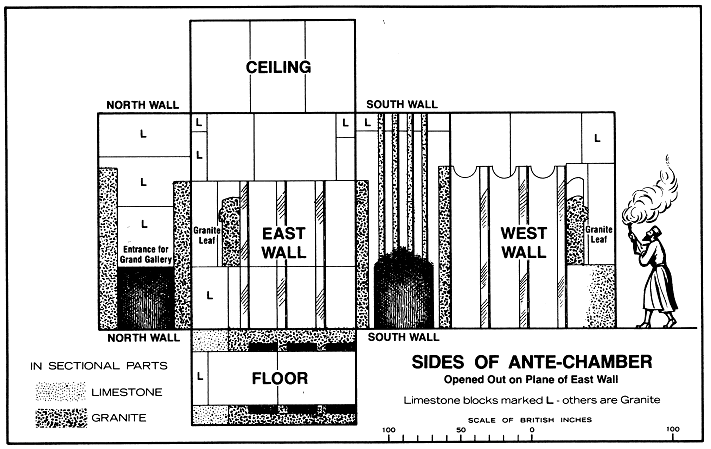
The “Granite Leaf” passed, we stand unhampered upon the granite
floor in the “Ante-Chamber.” (See
illustration.) This is a peculiar room: its walls are different from each
other; it seems to have a kind of wainscoating on parts; and in some of
its walls grooves are cut. It
certainly seems to be [page 352]
full of lessons not yet fully deciphered.
However, the suggestion of those who have visited it, that it
resembles a schoolroom, seems in perfect harmony with what we should
expect as representing the experiences of those sanctified ones begotten
of the Truth. This
“Ante-Chamber” symbolizes the school of Christ, and the
discipline—the trials of faith, patience, endurance, etc.—to which all
are subjected who have made a full consecration of themselves to the will
of God; which affords them opportunities for overcoming, and for proving their worthiness of a place, as
overcomers, with Christ in his coming reign of glory. If we be without such lessons and trials, we are not sons
and heirs
on this divine plane. (Heb. 12:8) It
is in the present life, after our consecration to his service, that God
schools and disciplines us, and thereby not only tests our fidelity to
him, according to our covenant, but also prepares us to sympathize with
others in trial and trouble, over whom he wills shortly to make us rulers
and judges. 1 Cor. 6:2,3
And not only the death of the will, but also actual death, must be
passed before we enter fully and actually the conditions of our “new,” “divine nature.”
And this, too, is shown by the stone “Witness”; for at the
farther end of the “Ante-Chamber” is a very low passage through which
entrance to the “King’s Chamber” is gained.
Thus the “King’s Chamber,” the grandest and highest room of
the Pyramid, becomes the symbol of the perfection of the divine nature to
be gained by the “little flock,” the few overcomers chosen out of the
“many called” (whose calling
is symbolized by the “Grand Gallery”), who pass through self-sacrifice
and trial (symbolized by the “Ante-Chamber,” and the low passages into
and from it). The call to the
“divine nature” came first to our Lord Jesus, whose mission to earth
was for a twofold purpose: (1) to save sinners by paying the ransom price
for Adam, and all in him, and (2) that by that obedience unto death he
might be proved worthy of the divine nature and
[page 353]
[page 354]
(Blank Page)
[page 355]
glory. Hence
it is that the “Grand Gallery” is shown as commencing at our Lord’s
birth. It does not,
therefore, symbolize the Gospel
age, for that did not commence until Jesus had made an end of the
Law age by his sacrifice on the cross, thirty-three years after his birth;
but it does symbolize the high or heavenly calling
(through sacrifice) to the divine nature—the “King’s Chamber.”
Our Lord Jesus was thus called from the moment of his birth; and,
since Pentecost, all justified believers are called to the same high
privilege, however few accept the call to sacrifice, and however few make
their calling and election sure by hearty compliance with the
conditions—walking in the Master’s footsteps. And the length of time
during which this “high calling” to the divine nature lasts, and when
it ceases, is what is indicated by this “Grand Gallery’s” length and
termination, as already shown.
The “King’s Chamber,” which can be reached only by way of the
“Grand Gallery” and the “Ante-Chamber,” is in every way the
highest and noblest apartment in the Great Pyramid, and fitly symbolizes
the divine nature. Mr. Henry
F. Gordon, describing it, says:
“It is a very noble apartment, 34 feet long, 17 feet broad, and
19 feet high, of polished red granite throughout; walls, floor and ceiling
in blocks squared, true, and joined together with such exquisite skill
that no autocrat emperor of modern times could desire anything more
solidly noble and refined. The
only thing this chamber contains is an empty [granite] coffer [or stone
box] without a lid; and it is worthy of notice that this coffer
corresponds with the sacred ark of the Mosaic Tabernacle in capacity.”
In the Great Pyramid granite is used to symbolize divine things or the divine nature,
just as gold symbolized it in Israel’s typical Tabernacle and Temple:
the low passages leading into the “Ante-Chamber” and into the
“King’s Chamber” correspond to the veils before the Holy and the
Most Holy; and the granite coffer, the only furniture in the “King’s
Chamber,” corresponds to the Ark of the Covenant, which was the only
furniture in the Most Holy of the Tabernacle and the Temple.
What in the one was gold, in the other is granite, and of the same
symbolic significance.
[page 356]
Nor is this all: we find that the same great truths which were
symbolically represented in the two apartments of the Tabernacle and the
Temple, the Holy and the Most Holy, and their separating veils, are
exactly matched in the Great Pyramid by the teachings of the two
apartments, the “Ante-Chamber” and the “King’s Chamber,” and
their low separating passages. The “Ante-Chamber,” like the Holy of the Tabernacle,
represents that condition of relationship to God, as a reckoned new
creature, and joint-heir with Christ of the divine nature and glory, which
the believer enters when,
after accepting forgiveness of sins and reconciliation with God through
the ransom, he presents his justified self a living
sacrifice to God’s service.
As the first veil of the Tabernacle represented the consecration or
resignation or death of our own will, and the full submission to God’s
will, so the low entrance to the “Ante-Chamber” symbolizes this same
great event, which begins the newness of life in all who will ever be
members of the royal priesthood.
This test, representing the laying of our all upon the altar,
having been passed, the believer is no longer reckoned
as a human being, but as a “new creature,” a “partaker of the divine
nature.” Though, as a matter of fact, he will not be made an actual
sharer of the divine nature until he shall have faithfully learned the
lesson of obedience to the divine will, in the actual experiences and
daily sacrifices and schoolings of the present life (represented in the
“Ante-Chamber” walls, of peculiar construction, and in the Table of
Shew-bread, the Golden Candlestick and the Incense Altar in the Holy of
the Tabernacle); and not until he shall have passed through death itself
(represented by the second veil of the Tabernacle and by the second low
passage leading into the “King’s Chamber” of the Pyramid); and
until, by a share in the First Resurrection, he shall have entered with
Christ into the fulness of the promised divine nature and glory—his
everlasting portion, symbolized in the “King’s Chamber.”
Thus the Great Pyramid witnesses, not only the downward course of
man in sin, but also the various steps in the divine plan by which
preparation is made for his full recovery from the fall, through the way
of life, opened up by the death and resurrection of our Lord Jesus.
[page 357]
It will be noticed from the illustration that the granite floor
does not reach quite to the front of the “Ante-Chamber,” while the
granite of the ceiling reaches the full length of the room.
This seems to teach a lesson in harmony with what we have already
seen to be a feature of the divine plan, as it relates to those called-out
ones who are seeking to enter upon the divine nature.
The first low passage symbolizes the consecration of the
believer’s human will, which really gives him entrance into the
“Holy” or sanctified condition as a prospective heir of glory and
immortality, represented in the “Ante-Chamber,” whose granite ceiling
now covers him; yet such a one is not to be considered as having entered
fully into the new nature until “quickened” into activity and newness
of life; and this test is represented by the “Granite Leaf,” which,
from its peculiar position, hanging, as though ready to drop and thus
block all further progress, seems to say, “Pilgrim, even though you have
come thus far and have consecrated yourself to God, unless you become
quickened by the spirit of the truth to activity in his service, you will
still have no real standing in the divine nature to which you have been
called or invited.” The
three steps by which the called ones of the Gospel age are to enter the
glory of their Lord are thus marked in the Great Pyramid as well as in the
Scriptures. They are (1) Consecration, or begetting of the spirit through the Word of
truth, symbolized by the low passage into the “Ante-Chamber”; (2) Quickening
to active service and sacrifice through sanctification of the spirit and
belief of the truth, symbolized by the low passage under the “Granite
Leaf”; (3) Birth
of the spirit into the perfect likeness of our Lord by a share in the
First Resurrection, symbolized by the low passageway into the “King’s
Chamber.”
The
Natural and Spiritual Natures Shown
By reference to the illustration, page 333, it will be noticed that
an imaginary line drawn through the vertical axis of the Great Pyramid
would leave the “Queen’s Chamber” and its “Horizontal Passage,”
the “Entrance Passage,” the “First Ascending Passage” and the
“Grand Gallery,” all on the north side of that line or axis, and only
the “Ante-Chamber” and the “King’s Chamber” on the south side of
[page 358]
it. By
this arrangement the designer of the Great Pyramid (Jehovah) points out to
us the distinction of natures, as noted in Vol. I, Chap. x.
The “Queen’s Chamber,” representing the perfection of
humanity after the Millennial age shall have restored all the obedient and
worthy ones to the moral likeness of the Creator, teaches, by the fact
that its back or farthest wall is on a line with the Pyramid’s axis,
that, thus restored to God’s image and likeness, though still human,
mankind will be close to the divine nature—as close as one nature could
be to another nature of which it is a likeness.
And all the upward passages leading in the direction of that axis
teach that the desires and efforts of God’s people are all to be toward
human perfection, while those of the called-out Church of the Gospel age
are to go beyond
human perfection. They, as joint-heirs with Christ, are to enter into the
fulness of the divine nature.
The fact that the “Subterranean Chamber” or “Pit,”
representing trouble and death, does not lie wholly on the same side of
the vertical axis as the “Queen’s Chamber” and its passage does not
militate against this interpretation; for, strictly speaking, it is no
part of the Pyramid structure at all.
It lies under the Pyramid, far below its basal line.
But it may have another lesson to impart.
A vertical line from its farthest wall would pass exactly along the
farthest wall of the “Ante-Chamber”; and the lesson drawn might be, in
harmony with the Scriptural warning, that it is possible for some who have entered the “Holy” or
sanctified condition (who have been begotten by the word of truth, and who
have even been quickened by it) to commit the sin that is unto death—the
second death.
So, then, the relation of the location of the “Pit” to the
axis, if it have any significance in connection with the arrangement of
the Pyramid above
it, would seem to indicate that the second death—endless, hopeless
destruction—will be the penalty, not only of the wilful sinfulness of
men who, during the Millennial age of blessed opportunity, will refuse to
go on to human perfection, but also of any of those sanctified during the
Gospel age, who wilfully reject Christ’s proffered and previously
accepted robe of imputed righteousness.
[page 359]
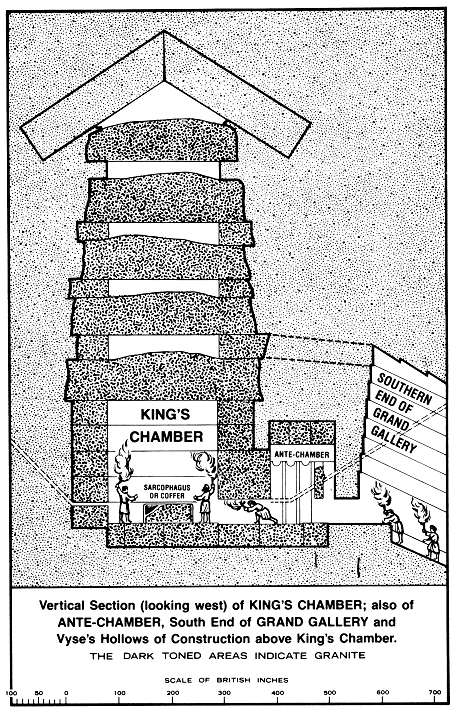
[page 360]
(Blank
Page)
[page 361]
Another item worthy of note in connection with the vertical axis of
the Great Pyramid’s structure above its basal line is this: our Lord’s
first advent and his death, marked by the “Well’s” mouth, are on
that side of the Pyramid’s axis which represents the human nature; and its location on the same level as the passage
leading to the “Queen’s Chamber,” which symbolizes human perfection, is also
noteworthy. The Great Pyramid thus seems to say: “He was made
flesh”—the man
Christ Jesus gave himself “a ransom for all”; yet he knew no sin, was
holy, harmless, separate from sinners, and had no part whatever in the
downward, sinful course of Adam’s race (symbolized in the passage to the
“Pit”). Moreover, the
location of the “Grotto” and the fact that it was natural and not hewn
are significant. It evidently
symbolizes the death of our Lord Jesus.
The fact that it was natural
teaches that the Lord’s sacrifice of himself was not an expediency, but
a foreordained, prearranged matter in Jehovah’s plan, before the
outworking of the plan symbolized by the Pyramid began.
The fact that it is located above and not below the basal line of
the Pyramid seems to teach another lesson in harmony with the
Scriptures—that though our Lord died as a ransom for sinners, he did not
descend into sin and degradation, but even in his death was within the
limits and bounds of the divine plan, as symbolized in the Pyramid
structure above the basal line.
Now a question of great interest arises: Will the Pyramid’s
testimony concerning the time of the close of the high calling corroborate
the testimony of the Scriptures on this subject?
Will it show the end of the “Grand Gallery” at the exact time
the Scriptures assure us that God’s call to this favor ceases?
Or will it contradict what we have learned from the Scriptures, and
show either a longer or a shorter period of calling to the divine nature?
This will be another “crucial test,” not however a test of
God’s Word and its wonderful testimony, which is paramount to all
others, but a test of this stone “Witness.”
Will it further prove its divine architecture by confirming the
Scripture testimony? or will it show more or less of a discrepancy? Should
it corroborate the Bible account particularly and minutely, it would
indeed well merit the name given it by Dr. Seiss—“A Miracle in
Stone.”
[page 362]
Well, we can say nothing less of it; for its testimony agrees fully
and in every detail with the entire plan of God as we have learned that
plan from the Scriptures. Its
wonderful correspondencies with the Bible leave no room for doubt that the
same divine inspirer of the prophets and apostles inspired this
“Witness” also. Let us
examine some of these harmonies particularly.
Call to mind that the Scriptures showed us that the full end of
Gentile power in the world, and of the time of trouble which brings its
overthrow, will follow the end of A.D. 1914, and that some time near that
date the last members of the Church of Christ will have been
“changed,” glorified. Remember, too, that the Scriptures proved to us
in various ways—by the Jubilee Cycles, the 1335 days of Daniel, the
Parallel Dispensations, etc.—that the “harvest” or end of this age
was due to begin in October, 1874, and that the Great Reaper was then due
to be present; that seven years later—in October, 1881—the “high
calling” ceased, though some will be admitted to the same favors
afterward, without a general call being made, to fill the places of some
of the called ones who, on being tested, will be found unworthy. Then look
at the manner in which the stone “Witness” testifies to those same
dates and illustrates the very same lessons.
Thus:
The floor-line of the “Grand Gallery,” from the north to the
south wall, has been twice very carefully measured in recent years, and
three distinct sets of measures have been obtained.
One measure (a) is from the wall at the north end, measured to the
“Step” and then—omitting its riser or front—along its upper
surface, the walking
surface of the “Grand Gallery’s” floor; another measure (b)
shows the length measured through the “Step,” as though the “Step” were not there;
another measure (c) gives the entire surface of the floor and up the front
or riser of the “Step” and along its top surface.
Prof. Smyth found the first of these measures (a) to be 1874
Pyramid inches, the second (b), 1881 Pyramid inches, and the third (c),
1910 Pyramid inches; while Mr. Flinders Petrie reports these measures
eight-tenths of [page 363]
an inch longer.
A reasonable estimate, therefore, and undoubtedly very nearly a
correct one, would be to call these figures (a) 1875, (b) 1882 and (c)
1911 Pyramid inches.
Now we inquire, If the inches of the floor-lines of these passages
represent a year, each, as claimed and admitted by Pyramid students, what
date would these measures of the “Grand Gallery” indicate as the end
of the high calling to the divine nature, which the “Grand Gallery”
symbolizes? We answer, that in applying these inch-years to our present
reckoning of time, we must remember that our date A.D. is one year and
three months behind the actual date, as shown in Vol. II, pages 54-62.
And while this would make no difference in calculating a period
from a fixed date B.C., or from a fixed date A.D., it should be recognized
in this case. Where the same
event, the birth of Jesus, is the starting point, the error in our date
A.D. must be allowed for, to reach correct results.
For simplicity we will take our erroneous A.D. as the standard, and
will scale down the Pyramid figures to correspond, by deducting one and
one-fourth inches from them, so that they will correspond with our common
reckoning. Thus reduced, they would show (a) 1875 less 1 1/4 equal 1873
3/4; (b) 1882 less 1 1/4 equal 1880 3/4; and (c) 1911 less 1 1/4 equal
1909 3/4, and give the dates (a) October, 1874, (b) October, 1881 and (c)
October, 1910 A.D.
This threefold ending is in full accord with what we have found
taught in the Scriptures: that the “harvest, the end of the age,” was
reached in October, 1874, and that the “call” proper ended in October,
1881, while a period would follow during which, though the general
call had ceased, the same privileges would be extended to some
worthy ones, in order to supply the places of some already among the
called who, under trial, will be found unworthy of the crowns allotted to
them when they accepted the call. How
long this sifting of the consecrated will last, during which some will be
granted the crowns of those adjudged unworthy, and their names written instead
of some whose names will be blotted out (Rev. 3:5,11), the Scriptures do
not, so far as we have yet seen, indicate; but this date, 1910, indicated
by the Pyramid, seems to harmonize well with the dates furnished by the
Bible. It is but a few years before the full close of the time of
trouble which ends the Gentile times; and when we remember the Lord’s
words—that the overcomers shall be [page 364]
accounted worthy to escape the severest of the
trouble coming upon the world we may understand the reference to be to the
anarchous trouble which will follow October, 1914; but a trouble chiefly
upon the Church may be expected about 1910 A.D.
Is not this a most remarkable agreement between this stone
“Witness” and the Bible? The
dates, October, 1874, and October, 1881, are exact, while the date 1910,
though not furnished in the Scriptures, seems more than a reasonable one
for some important event in the Church’s experience and final testing,
while A.D. 1914 is apparently well-defined as its close, after which the
world’s greatest trouble is due, in which some of the “great
multitude” may have a share. And
in this connection let us remember that this date limit—A.D. 1914—may
not only witness the completion of the selection and trial and
glorification of the entire body of Christ, but it may also witness the
purifying of some of that larger company of consecrated believers who,
through fear and faint-heartedness, failed to render acceptable sacrifices
to God, and who therefore became more or less contaminated with the
world’s ideas and ways. Some
of these, before the end of this period, may come up out of the great
tribulation. (Rev. 7:14) Many
such are now being closely bound in with the various bundles of tares for
the burning; and not until the fiery trouble of the latter end of the
harvest period shall burn the binding cords of Babylon’s bondage shall
these be able to make their escape—“saved so as by fire.”
They must see the utter wreck of Great Babylon and receive some
measure of her plagues. (Rev. 18:4) The
four years from 1910 to the end of 1914, indicated thus in the Great
Pyramid, will doubtless be a time of “fiery trial” upon the Church (1
Cor. 3:15) preceding the anarchy of the world, which cannot last
long—“Except those days should be shortened there should no flesh be
saved.” Matt. 24:22
Nor is this all of the wonderful symbolism of the Great Pyramid.
Its marvelous harmony with the divine plan is still further shown
in another remarkable feature. We should expect that the date of the two great events
connected with the close of this age, viz., (1) our Lord’s second advent
and (2) the beginning of the harvest, would in some [page 365]
manner be marked at the upper end of the “Grand
Gallery,” even as his death and resurrection are marked by the
“Well” at its lower end. And
in this we are not disappointed. In the upper or south end of the east
wall, at its top, high above the step, there is an opening connecting with
the unfinished space above the “King’s Chamber,” as shown on the
diagram. In the Pyramid’s
symbolic language that opening says, “Here a heavenly One entered—One
who needs no floors to walk upon, but who can come and go like the
wind.” And Prof. Smyth’s
careful measurements of this south wall of the “Grand Gallery” inform
us that it is not exactly perpendicular, but leans over at the top seven inches.*
The Pyramid thus says to us, “Seven years before the close of the high
calling [before October, 1881] the great One from the heavens will
enter.” And it further
indicates that from that time—October, 1874—gradually, as indicated by
the sloping of the south wall, the call would be drawn to a close and
fully end in October, 1881. This,
it will be noticed, is in exact accord with the Bible’s testimony as
outlined in this and preceding volumes of Studies in the Scriptures.
—————
*Prof.
Piazzi Smyth’s report.
And let it be remembered, too, that we who understood the
Scriptural presentation of these times and seasons had nothing to do with
the taking of these measurements of the Great Pyramid; and that they who
took the measurements knew nothing of our application of the prophecy at
the time the measurements were taken, nor do they yet, so far as we know.
We ask, therefore, Could such exactness in matters which concern
six thousand years of history on the one hand, and thousands of inches of
Pyramid measurements on the other, be a mere accidental coincidence?
Nay; but verily truth is stranger and more wonderful than fiction.
“This is the Lord’s doing; it is marvelous in our eyes.”
Further, where the special favor of the general Gospel call ceased
(October, 1881), the blessing upon the world would seem to be due to have
a beginning. The “Well,”
which marks at its upper end the ransom which secures the coming blessing,
should, it would seem, at its lower end (where it connects with the
downward passage) mark the date when restitution blessings would begin to
reach the world. It seems to say, Here the benefits of the ransom will [page 366]
begin to bless all the families of the earth, when
the elections or selections of the Jewish and Gospel ages are completed.
Now if we adopt the clearly marked close of the special call and
favor of the Gospel age, 1881, as the date at which the call to
restitution blessings was due to have a beginning, and if we regard the
lower terminus of the “Well” as marking that date (1881), we find
something of interest by measuring back along that “Entrance Passage”
to the original entrance of the Pyramid.
This distance we find to be 3826 pyramid inches, thus representing
3826 years. And if our
supposition be well founded, 3826 years before A.D. 1881 some notable
event must have occurred. And
as we search the historic records of God’s Word to see if any notable
event occurred at that time, we find a remarkable confirmation of our
supposition; for, just 3826 years before A.D. 1881, which would be B.C.
1945, Isaac, the typical seed of promise, became the heir of all his
father Abraham’s wealth, and was thus in position to bless all his
brethren—Ishmael, the son of Hagar (type of fleshly Israel), and the
many sons and daughters of Keturah, Abraham’s second wife (typical of
the world in general).
Thus the “Entrance Passage,” from the outside edge down to the
nearest edge of the passage connecting with the “Well,” marks in
year-inches the period of time from the day the typical Isaac (in whom
typically centered the promise of blessing to the world) became heir of
all, B.C. 1945, to A.D. 1881, when the blessing was actually due to the
world through the antitypical Isaac—the Christ, the heir of all things.
Gal. 3:16,29
We measure the time from the date of Isaac’s inheritance, and
consequent privilege of blessing his brethren, to the year A.D. 1881,
thus: Isaac came into possession of his inheritance at the death of his
father Abraham, which occurred 100 years after the Abrahamic Covenant was
made (for Abraham was 75 years old when the Covenant was made, and he died
at the age of 175 years). Then
from the Covenant to the death of Jacob, Isaac’s son, was 232 years;*
and from the time that Isaac came into his inheritance—100 years after
the Covenant was made—to the death of Jacob would be 132 years (232
years less 100 years). To
this we add the 1813 years from the death of Jacob to our Anno Domini, and we have the
date 1945 B.C., the date when the typical Isaac came into possession of
all that Abraham had. (Gen. 25:5) And
this 1945 years B.C. added to the 1881 years A.D. makes the 3826 years
indicated in the Pyramid inches as the length of time that must elapse
between the typical blessing of his brethren by the typical seed, Isaac,
and the blessing of the whole world through the antitypical Isaac, the
Christ.
—————
*See
Vol. II, pages 231,232.
[page 367]
Does the question arise with any, what beginning of restitution
work was marked by October, 1881? We
answer: Nothing occurred which the world could discern.
We still walk by faith and not by sight. All the preparatory steps toward the great restitution work
since the date 1881 are to be reckoned as droppings of the great shower of
blessing which shall ere long refresh the whole earth.
That which occurred in 1881, like that which occurred in 1874, can
be discerned only by the eye of faith in the light of God’s Word.
It was the date of the close of the high calling, and hence the
date for the beginning of restitution announcement—the Jubilee trumpet.
About that date the author, and, so far as he knows, no one else,
had noticed the distinction between the call to the divine nature, open
during the Gospel age, and the opportunity for restitution of human perfection and all that was lost in Adam, due at the close
of the Gospel high calling.*
Another point to be noticed is, the pathway upon which
the world will be invited to come and receive life
everlasting in the Millennial age.
—————
*Although
we had not thought of the coincidence until now, while writing
this chapter, it is not a little remarkable that it was during the
last six months of the year
1881 that Food for Thinking Christians, a book of
166 pages, was issued, and circulated to the extent of one million
four hundred thousand copies
throughout the United States and Great Britain.
Three items connected with that book and its wide and sudden
distribution contribute to
mark it as at least peculiar: (1) Perhaps no other
book ever reached so large a circulation in so brief a space of
time, or by the same methods. It was distributed gratuitously at the church doors in
all the largest cities of the United States and Great Britain by
the messenger boys of the
District Messenger Service on three successive Sundays,
and in the smaller towns through the mails.
(2) The money to defray
this expense ($42,000) was voluntarily
donated for the purpose, without
solicitation. (3) It was, so
far as we know, the first book ever published
which pointed out the distinction between the high calling of the
Gospel Church and the Restitution favors for the world in general,
and it pointed out the date
of the close of that high calling as October, 1881.
[page 368]
As the upper apartment, known as the “King’s Chamber,”
represents the divine
nature, and the “Grand Gallery” represents the call to it, so
the one under it (the “Queen’s Chamber”) represents the perfect human nature; and the way
to it illustrates the path to life in which the world must walk to reach
human perfection during the Millennium.
Both of these ways, and hence both of these ultimate results, were
opened up and made possible by the ransom-sacrifice
which the Mediator gave on behalf of all: all of which is forcibly
indicated in the Pyramid by the “appearance of an explosion,” which
opened the mouth of the “Well,” and gave access to the two passageways
(intended to symbolize the call of the Church now, leading to the divine
nature, and the call of the world during the Millennium, leading to the
restitution of human perfection).
Thus the Great Pyramid, in harmony with the Scriptures, declares
that “Christ brought life [restitution to human life, represented in that called the
“Queen’s Chamber”] and immortality
[the divine nature, represented in that called the “King’s Chamber”]
TO LIGHT, through the Gospel”—the good news of redemption. 2 Tim. 1:10
The only entrance to the “Queen’s Chamber,” or to the
“Grand Gallery,” was by way of the “Well,” the “First Ascending
Passage” having been originally impassable by reason of the granite
“Plug.” Thus the stone
“Witness” testifies that by the Law Call or Law Covenant none of the
fallen race could reach either life (human life) or immortality (the
divine nature). Though the
“First Ascending Passage” was a way, yet none could walk in it.
So the Law Covenant was a passageway to life; but because of the
weakness of the flesh, none could walk in it so as to attain the life
offered. (Rom. 3:20) The
cross, the sacrifice, the ransom, is thus specially marked by this stone “Witness,” just as in the
Scriptures it is more prominently marked than any other feature of the
plan. “No man cometh to the
Father but by me,” said Jesus. “I
declared unto you first of all that which I also received [first of all],
how that Christ died for our sins,” said Paul. (1 Cor. 15:3)
“The ‘Well’ [representative of Christ’s sacrifice and
resurrection] is the [page 369]
only way to life and immortality,” says the Great
Pyramid.
The passage to the “Queen’s Chamber” is low, and the traveler
must humbly bow his head to its requirements. The path of right-doing has
always been one of humility and will be so in the Millennium, when all will be required to
bow to the strict regulations of Christ’s Kingdom. He will rule with an iron rod. (Rev. 2:27)
He will then lay judgment to the line, and righteousness to the
plummet; and to his greatness and power every tongue must
confess, and to his rule and law every knee must bow; so that in his
day the humble and righteous, and they only, shall flourish. Isa. 28:17;
Rom. 14:11; Psa. 92:12,13
The “Queen’s Chamber” symbolizes the end of the restitution
work—human perfection—in that it has seven
sides, counting the floor one side, and the roof two sides, as shown in
the diagram. The path to it
tells the same story of sevenness, or perfection, for the floor of it is
depressed for one-seventh of its length.
And not only is the number seven a general symbol of perfection and
completeness, but it is specially suggestive in this connection, since the
Millennial age is the seventh thousand years of the earth’s history, and
the one in which perfection is to be attained by the willing and obedient
of the race.
Prof. Smyth remarks the peculiarity of the floor of this
“Queen’s Chamber” and the passageway leading to it, that it is rough
and entirely unfinished, thus differing from the other passages, which
were originally very smooth, probably polished.
This, he suggests, may indicate that its floor is not subject to
measurement by year-inches as are the other passages—as if the Pyramid
by this unevenness would say, “Time-measures are not recorded here.”
But though the Pyramid inch-year is not observed in the passage to
the “Queen’s Chamber,” nor in its floor, another matter did require
to be shown, namely, the
way of restitution to perfect life and perfect human organism.
As this perfection of human nature is illustrated in the
“Queen’s Chamber,” so the way to it represents the seven thousand
years of experience and discipline through which the fallen human race
must pass before full restitution to perfection can be gained.
Inasmuch as the first six-sevenths of the passageway to the
“Queen’s Chamber” is extremely low, it [page 370]
represents the six thousand years past, and
illustrates the extreme difficulty and humility necessary to walk a
justified life, even on the part of such as sought so to walk—the
patriarchs, prophets and others, justified through faith—during this six
thousand years of the reign of sin and death. On the contrary, the last
seventh of the way represents the Millennial age, just dawning
upon men. Its height being
nearly twice as great indicates that during the coming thousand years of
grace and peace on earth men can progress with comfort and ease toward
full perfection.
Is it asked whether any have walked in this way during the past six
thousand years? We answer,
Yes; by
faith some have walked in it.
It is the way of justification
of human nature, though wholly different from the way and calling
of the Gospel Church, which, though through justification, is to the new,
divine nature. Abraham, Isaac
and Jacob and the faithful prophets walked that way—entering by the
“Well”—by faith in the ransom-sacrifice
of Christ, which they represented by typical sacrifices before our
Lord’s death, and before the stone “Witness” pointed to it; for in
God’s purpose and revelation Christ was the slain Lamb of atonement from
before the foundation of the world.
And this way to the “Queen’s Chamber” agrees well with the
Bible record concerning the way to perfect human nature and life during
the Millennium. The length of
time needed to reach perfection will differ in individual cases, according
to the rapidity or slowness of the individual to submit his heart and life
to the conditions of the New Covenant. It will no longer be a struggle
upward, continually opposed by downward tendencies within and without, as
it has been during the Law and Gospel dispensations; but it will be a way
in which everything will favor the traveler, and facilitate his rapid
progress toward full perfection of restitution-life, with all its
resultant blessings.
As the “King’s Chamber,” by its ventilating tubes, indicates
that it symbolizes a permanent residence, an everlasting condition, so the
“Queen’s Chamber” symbolizes the fact that the condition of human
perfection, when reached, may be made an everlasting
state; for it also has similar ventilating tubes or air passages provided.
In one case we may say it symbolizes a permanent condition, and in
the
[page 371]
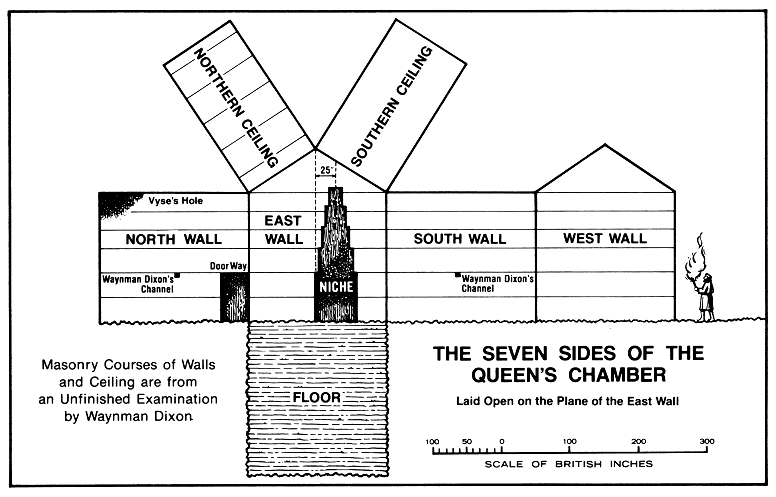
[page 372]
(Blank Page)
[page 373]
other that it may
be made a permanent or everlasting condition, because this is the
fact as indicated both by the Scriptures and by the testimony of the stone
“Witness.” The Scriptures
say of those who attain the condition represented by the “King’s
Chamber,” that they partake of the divine nature, and are immortal, or proof against death—that they cannot die
thereafter. And they show
that those others who reach the full restitution, and stand the last test
of loyalty, at the end of the Millennial age, though they will not possess
that quality termed Immortality,
which is essentially an element of the divine nature only, will be
supplied with life everlasting under provisions already arranged by the
great Architect of the plan of salvation.
If they abide in harmony with God and in obedience to his will,
they will live forever.
The Great Pyramid declares these same truths; for while the
“King’s Chamber” had open ventilators, the ventilators in the
“Queen’s Chamber” were originally peculiarly covered. The air-tubes
were complete from the outside of the Great Pyramid to within about five
inches of the surface of the inner walls of the “Queen’s Chamber,”
the stones on either side of the “Queen’s Chamber,” except the said
five inches in thickness, having been chiseled out, showing design on the
part of the Great Pyramid’s Architect, just as every other feature shows
it. Mr. Waynman Dixon made
this discovery while examining the walls of the “Queen’s Chamber.”
He noticed that the wall at a certain spot sounded hollow, and,
breaking through the surface, he found one ventilating tube; and then by
the same process he found its mate in the opposite wall.
Thus the Pyramid, in harmony with the Scriptures, declares that ample
provision has been made, whereby the perfect human condition,
represented by the “Queen’s Chamber,” may
be an everlasting condition to each one who conforms to its
regulations and laws.
And now, having heard it speak, what shall we think of the stone
“Witness” and its testimony? Such
testimony would be peculiar and striking indeed, even if there were no
scriptures found to bear on the subjects examined; but when the Scriptures
had already clearly and positively declared to us these same circumstances
and dates, before the [page 374]
Pyramid’s testimony was heard, its wonderful
agreement with and corroboration of the same become doubly significant and
striking. Now, when the
worldly-wise are repudiating God’s Word as “obsolete” and
“unscientific,” to have this stone “Witness” speak, and
corroborate the testimony of the Bible, is truly astounding.
To hear its testimony as to man’s fall at the very time that the
worldly-wise are claiming that man never was perfect, never was in God’s
image, and consequently never fell from it, is remarkable. To hear its
testimony that none
could enter either the Gospel high calling to the divine nature or the
state of human justification and life through the Law Covenant or
passageway, at a time when so many are preaching that the Law of Moses is
the only way to life, is certainly gratifying. Surely in the Great Pyramid
“The invisible things [plans] of God from the creation of the world are
clearly seen; being understood by the things that are made.” Rom. 1:20
Some may scoff at the testimony of this stone “Witness,” as
they also scoff at God’s written Word; but to their scoffs we answer:
Account for this peculiar fitness of things, or else venture to prophesy
of the future, and see how your prophecies will result.
Prove to us that it requires no inspiration to foretell future
events. Show us a sample of
worldly wisdom. “Produce
your cause, saith the Lord; bring forth your strong reasons, saith the
King of Jacob. Let them bring them forth and show us what will happen; let
them show the former things, what they
be, that we may consider them and know the latter end of them; or declare
to us things to come. Show
the things that are to come hereafter, that we may know that ye are gods
[mighty ones].” Isa. 41:21-23
Not only does the Great Pyramid confound atheistical scientists,
but it refutes utterly their modern and anti-Scriptural theory of
“Evolution”—on which subject we cannot do better than quote the
following words of Dr. Joseph Seiss, from his excellent treatise on the
Great Pyramid, entitled “A Miracle in Stone.”
He says:
“If the primeval man were nothing but a gorilla or troglodyte,
how, in those prehistoric times, could the builders of this mighty
structure have known what our profoundest [page 375]
savants, after a score of centuries of observation and
experiment, have been able to find out only imperfectly? How could they
know how even to make and handle the tools, machines and expedients,
indispensable to the construction of an edifice so enormous in dimensions,
so massive in its materials, so exalted in its height and so perfect in
its workmanship that to this day it is without a rival on earth?
How could they know the spherity, rotation, diameter, density,
latitude, poles, land distribution and temperature of the earth, or its
astronomical relations? How
could they solve the problem of the squaring of the circle, calculate the
proportions or determine the four cardinal points?
How could they frame charts of history and dispensations, true to
fact in every particular, for the space of four thousand years after their
time, and down to the final consummation?
How could they know when the Mosaic economy would start, how long
continue, and in what eventuate? How
could they know when Christianity would be introduced, by what great facts
and features it would be marked, and what would be the characteristics,
career and end of the Church of Christ?
How could they know of the grand precessional cycle, the length of
its duration, the number of days in the true year, the mean distance of
the sun from the earth, and the exact positions of the stars at the time
the Great Pyramid was built? How could they devise a standard and system of measures and
weights, so evenly fitted to each other, so beneficently conformed to the
common wants of man, and so perfectly harmonized with all the facts of
nature? And how could they
know how to put all these things on record in a single piece of masonry,
without one verbal or pictorial inscription, yet proof against all the
ravages and changes of time, and capable of being read and understood down
to the very end?
“Men may sneer, but they cannot laugh down this mighty structure,
nor scoff out of it the angles, proportions, measures, nature references
and sacred correspondencies which its Maker gave it.
Here they are in all their speaking significance, stubborn and
invincible beyond all power to suppress them.”
The voice of this wonderful “Witness” brings forcibly to mind
the words of our Lord on that notable occasion of his [page 376]
triumphal entry into Jerusalem, when he typically
presented himself to Israel as their king, amidst the acclamations of the
whole multitude of his disciples, who were loudly praising God for the
mighty works that had been done, saying, “Blessed be the king that
cometh in the name of the Lord! peace in heaven, and glory in the
highest.” And when the Pharisees were urging him to rebuke them, he
answered, “I tell you that if these should hold their peace, the stones
would immediately cry out.” (Luke 19:37-40) And so it is today: while
the King of glory has actually come, and while the great majority of his
professed living witnesses, who should be loudly rejoicing, and saying,
Blessed be the King that cometh in the name of the Lord, are dumb—some
from fear of being put out of the synagogue, and some from drowsy
slothfulness, or from the intoxication of worldliness which keeps them in
ignorance of the time of our visitation—lo, the very stones of this
Great Pyramid of Testimony are crying out in no uncertain tones. Every
inch of this massive structure is eloquently proclaiming the wisdom and
power and grace of our God.
Firmly incased in this solid rocky structure, beyond the power of
nature’s storms or of the ruthless hand of the destroyer, the outline
drawings of God’s great plan have stood for four thousand years,
prepared to give their testimony at the time appointed, in corroboration
of the similarly revealed, but for ages hidden, testimony of the sure Word
of Prophecy. The testimony of this “Witness to the Lord in the land of
Egypt,” like that of the written Word, points with solemn and unerring
precision to the final wreck of the old order of things in the “Pit”
of oblivion, and to the glorious establishment of the new, under Christ
Jesus, the great Chief Corner-stone of God’s eternal building, in
conformity with the lines of whose glorious character all things worthy of
everlasting existence must be built up under him.
Amen! Amen! Thy
Kingdom come! Thy will be done on earth as it is done in heaven!